Putting Jesus in His Place: The Case for the Deity of Christ by Robert M. Bowman Jr. & J. Ed Komoszewski
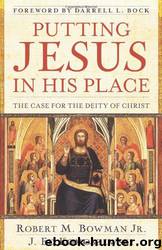
Author:Robert M. Bowman Jr. & J. Ed Komoszewski [Bowman, Robert M. Jr. & Komoszewski, J. Ed]
Language: eng
Format: epub
Tags: [k]
ISBN: 9780825429835
Amazon: 0825429838
Publisher: Kregel Publications
Published: 2007-08-29T17:00:00+00:00
He's Got the Power!
Christ's healing of the paralytic was just one of numerous miracles he performed during his earthly ministry. Although skeptics typically dismiss the Gospel miracle narratives out of hand as myth or legend, there are good reasons to conclude that these accounts, at least in general, reflect historical fact. Non-Christian sources dated as early as the first century refer to Jesus' reputation for performing miracles-although sometimes these sources denigrate Jesus' miracles as sorcery. Although the apostle Paul does not discuss any specific miracles of Jesus, there are traces in his writings of an awareness that Jesus performed them (Rom. 15:18-19; 1 Cor. 4:20; 13:2; cf. 2 Cor. 12:12; 2 Thess. 2:9). Furthermore, all of the Gospels, and all of the source materials that biblical scholars think the Gospels incorporated, attest to Jesus' miracles. Minimally, historians can say with full confidence that the belief that Jesus performed miracles originates from his own lifetime and is not the product of later myth or legend.10 Internally, the Gospels exhibit remarkable restraint in their miracle narratives, lacking many of the elements common to legendary tall tales." In his cautious and thorough study of the historicity of the Gospel accounts of Jesus' miracles, Graham Twelftree concludes that "there is hardly any aspect of the life of the historical Jesus which is so well attested as that he conducted unparalleled wonders." 12
Jesus was not, of course, the only person in the Bible to perform miracles. In the Old Testament, the human beings with whom miracles are most associated are Moses, Elijah, and Elisha. According to the book of Acts, the apostles, especially Peter and Paul, also performed miracles. We therefore must be careful not to oversimplify the matter; miracles in and of themselves do not prove that the human agent involved is deity.
New Testament scholar Werner Kahl helpfully distinguishes three kinds of miracle workers. A person who has inherent healing power he calls a "bearer of numinous power" (BNP). He uses the term "petitioner of numinous power" (PNP) for those who ask God to perform the miracle. Between these two extremes is the category of "mediator of numinous power" (MNP), which applies to persons who mediate the numinous power of a BNP in order to produce a miracle." Being a MNP or PNP clearly is not evidence of deity, whereas being a BNP could be evidence of deity.
Eric Eve, in his published dissertation The Jewish Context of Jesus' Miracles, observes that in the Old Testament, Yahweh is the only BNP; Moses is an example of an MNP; Elijah is an example of a PNP.14 Eve provides a compre hensive review of miracles in the Judaism of the New Testament period. He considers beliefs about miracles in Josephus, Philo, the wisdom and apocalyptic literature of the period (e.g., Wisdom of Solomon; 1 Enoch), some Qumran texts, and in some examples of romantic, fanciful Jewish literature of the time (e.g., Tobit). He finds that with rare (and quite marginal) exceptions, Judaism in that period agreed with the Old Testament in viewing the Lord God as the only BNP.
Download
This site does not store any files on its server. We only index and link to content provided by other sites. Please contact the content providers to delete copyright contents if any and email us, we'll remove relevant links or contents immediately.
The Five People You Meet in Heaven by Mitch Albom(3627)
The Secret Power of Speaking God's Word by Joyce Meyer(3409)
Real Sex by Lauren F. Winner(3061)
Name Book, The: Over 10,000 Names--Their Meanings, Origins, and Spiritual Significance by Astoria Dorothy(3010)
The Holy Spirit by Billy Graham(3000)
0041152001443424520 .pdf by Unknown(2895)
How The Mind Works by Steven Pinker(2864)
ESV Study Bible by Crossway(2812)
Ancient Worlds by Michael Scott(2721)
Churchill by Paul Johnson(2637)
The Meaning of the Library by unknow(2627)
The ESV Study Bible by Crossway Bibles(2581)
The Gnostic Gospels by Pagels Elaine(2564)
MOSES THE EGYPTIAN by Jan Assmann(2454)
Jesus by Paul Johnson(2408)
City of Stairs by Robert Jackson Bennett(2397)
The Complete Dead Sea Scrolls in English (7th Edition) (Penguin Classics) by Geza Vermes(2313)
The Nativity by Geza Vermes(2248)
Ancient Near Eastern Thought and the Old Testament by John H. Walton(2243)
